Before the Leisure Centre: How People Shared Recreation in Everyday Places
Explore how parks, halls and clubs served shared recreation before leisure centres, and choose a gathering place that fits your group and activity.
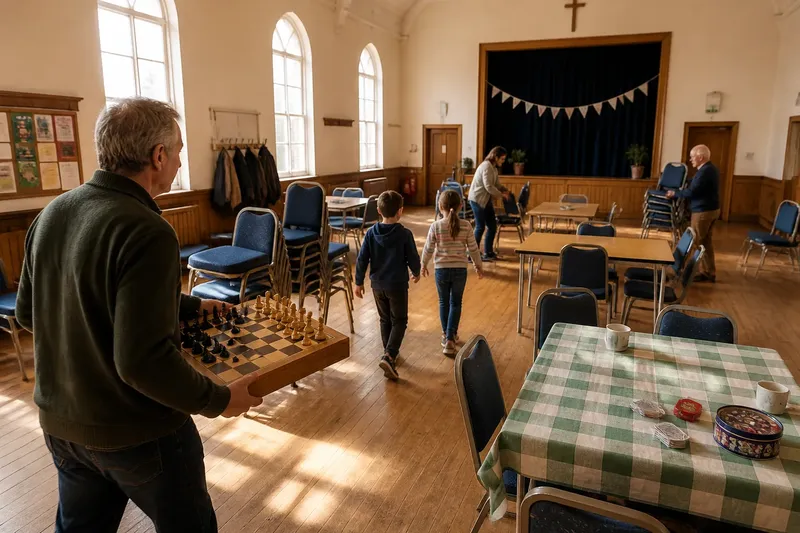
A neighbour carries a chessboard into a church hall while children weave between stacked chairs. Before purpose-built leisure centres became familiar in many communities, people also gathered for recreation in parks, reading rooms, pubs, clubs, baths and borrowed halls. Which places were available, and who felt welcome in them, varied by town, period and local custom.
That history is useful less as a story of a single path to the leisure centre than as a reminder that recreation can take place in ordinary settings. A good gathering space gives people what their activity requires: room to move, shelter, a place to sit or a reason to meet.
What places supported shared recreation before leisure centres?
There was no single pattern across Britain, or across different periods. In some communities, people adapted places already used for worship, work, learning, refreshment or exercise. Existing furniture, rules and expectations shaped what a group could do there.
- For room to move: a park, green or promenade could suit walking, informal games and public festivities. Open space allowed a gathering to expand or contract, while weather and daylight could complicate plans.
- For shelter and a shared floor: a village hall, schoolroom or community room could host dancing, music, talks and indoor games. Someone might need to arrange access, move furniture and restore the room afterwards.
- For conversation: a café, reading room or pub offered a place to sit and spend time. Its customs, noise and expectations about buying something affected whether it suited a particular group.
- For a particular activity: baths, sports grounds and clubrooms brought people together around swimming, team play or organised practice. Facilities and schedules limited what could happen and when.
These are broad possibilities, not a universal historical sequence. A hall could serve different purposes on different days, while a park might be a quiet walking route or a setting for a public celebration. The practical question is what a place made possible for its users.
How did local customs shape these gathering places?
Some recreation took place where people already met through daily routines. A village green or public square might also host games, performances or seasonal gatherings. What happened there depended on local practice; it would be misleading to treat every such place as an open venue for everyone.
Other settings connected leisure to learning, work or organised activity. Reading rooms and libraries offered places for reading; clubs and institutes could combine social life with education or mutual aid. Parks, baths and sports grounds supported outdoor recreation or particular physical pursuits, but their availability and rules differed from place to place.
Access was not always equal. Cost, opening hours, gender expectations, social standing and local customs could affect who entered, lingered or helped decide how a space was used. A place might be described as public and still feel unfamiliar or closed to some neighbours.
Which setting fits your group’s plans?
What works when attendance is uncertain?
A park, public square or café with flexible seating can accommodate people arriving at different times. Walking, conversation and casual games are easier to adapt than a fixed team match or tightly arranged performance.
Where can people move or make noise?
A hall, outdoor court or field may suit dancing, music or active games better than a reading room or small café. Check that the activity is permitted and that the space fits the movement involved, rather than relying on the venue’s name alone.
What suits people who want different levels of involvement?
A walk, shared meal or open club session can let someone join gradually, watch for a while or take a break. For a structured game, a role such as keeping score or arranging refreshments can make participation less dependent on confidence or experience.
What if weather or access may prevent attendance?
An indoor room near suitable transport may be a better choice if rain, cold, uneven paths or distance would make an outdoor plan difficult. If being outside is central to the gathering, identify a nearby sheltered alternative and tell people where it is.
How can you choose a gathering space that works?
Start with the activity, then check the venue’s conditions with its operator or local authority. For each observation, decide whether to keep the plan, change the activity or choose another place.
- Permission: Check whether the activity is allowed and who must approve it. If permission is clear, keep the venue; if it is not, ask the operator or choose a place with clear approval.
- Access: Check the route, entrance, seating and facilities against the needs people have shared. If the space is usable for the group, proceed; if not, find a more accessible venue or alter the plan.
- Sound and movement: Check whether the activity needs a clear area or could disturb other users. If the space suits it, keep the activity; if not, move to a hall, field or quieter gathering.
- Arrival and departure: Check whether people can arrive late or leave early without disrupting the event. If they can, a flexible format should work; if not, choose a less tightly scheduled activity or a different space.
- Furniture and equipment: Check what is already available and what the group must carry. If the necessary items are on site, use them; if not, simplify the activity or arrange another venue.
- Cost and expectations: Check whether entry, membership or a purchase is expected. If that is comfortable for everyone, retain the venue; if it may exclude someone, choose a no-purchase or lower-barrier option.
- Weather and comfort: Check for shade, shelter, seating and a nearby indoor alternative. If the conditions suit the gathering, keep the outdoor plan; if not, move indoors or choose a more sheltered location.
Imagine a neighbourhood group planning an informal card-and-tea evening in a community room. They learn that the room allows conversation, has chairs, and is reachable for the people they have invited, but the tables must be returned to their original places. They decide to use the room, bring a pack of cards and tea supplies, and keep the layout simple; the expected result is a relaxed gathering that can absorb late arrivals, with a clear tidying task at the end.
What is not worth the effort?
Trying to recreate an idealised old club, hall or pleasure garden is rarely useful. Those places belonged to particular communities and circumstances; copying their appearance can distract from whether the people gathering now can use the space comfortably.
Nor does a venue need an impressive list of facilities. A plain room that is easy to reach and suits the activity may serve better than a grand space with restrictive rules or an awkward layout.
Why does recreation in everyday places still matter?
Shared recreation before leisure centres did not follow one uniform route. In different places, people made use of parks, borrowed rooms and venues intended for other purposes, within the opportunities and limits of their local settings.
That context can help when choosing a gathering place today: begin with what people want to do together, then check what the venue makes easy and who can use it. For shared recreation, a suitable place is one where people can arrive, take part and feel there is room for them.